MOLI Security Overview
private cloud · zero shared tenants · quantum-safe
Security is architecture, not an afterthought
Your proprietary manufacturing data represent years of investment — and real responsibility. You should be able to verify your deployment, control access, and expect the same standard of care from a vendor that you demand internally.
From physical controls to post-quantum cryptography, MOLI's security posture is active, layered, and proven.
- 1:1 Dedicated server per customer
- NIST PQC Post-quantum ready encryption
Protection at every layer
General Protection
A mutual NDA is signed with every customer before work begins. All Perdix employees sign NDAs and Invention Assignment Agreements upon hire and are subject to background checks. Employees are trained to treat all data as confidential; access to customer systems and data is granted strictly on a need-to-know basis. All access is terminated immediately on offboarding.
Physical Security
MOLI cloud infrastructure runs on Amazon Web Services — SOC 2 Type II, ISO 27001, and FedRAMP-authorized data centers with biometric access controls, monitoring, and redundant power. Perdix offices use logged keyfob entry, a formal building sign-in procedure, a secure lockbox for printed material and removable media, and a fully isolated guest/device Wi-Fi network with no path to corporate infrastructure.
Identity & Access Management
MOLI supports Multi-Factor Authentication via TOTP app, security key, SMS, email, or voice call. Single Sign-On via OIDC is supported as both consumer and provider. On the floor, kiosk-optimized single-factor (employee ID, barcode, keyfob) minimizes friction while maintaining accountability. Role-based access control and Explicit Mode limit access to what is appropriate to that user at that location.
Dedicated Infrastructure
Every customer has their own private server — never a shared multi-tenant environment. Each deployment uses unique service keys for every external integration so a compromise in one deployment cannot reach another. Perdix staff have no routine access to customer infrastructure; access is granted to specific individuals for specific reasons at specific times only.
Network Access Controls
Network access to each MOLI server is restricted by customer-specific firewall rules at the infrastructure level. HTTPS is enforced on all endpoints; all traffic uses TLS 1.3 with forward-secret cipher suites. HTTP Strict Transport Security (HSTS) and secure cookie attributes are enforced platform-wide. Inbound port exposure is minimized to only what is operationally required.
Software Development Security
All service keys and secrets are stored separately from source code. Source code is maintained in a controlled-access repository supporting multi-factor authentication. Every change undergoes formalized peer review and test suites are run before deployment. Developers have no routine access to customer data — access is granted only to diagnose specific issues in specific environments.
Software Bill of Materials
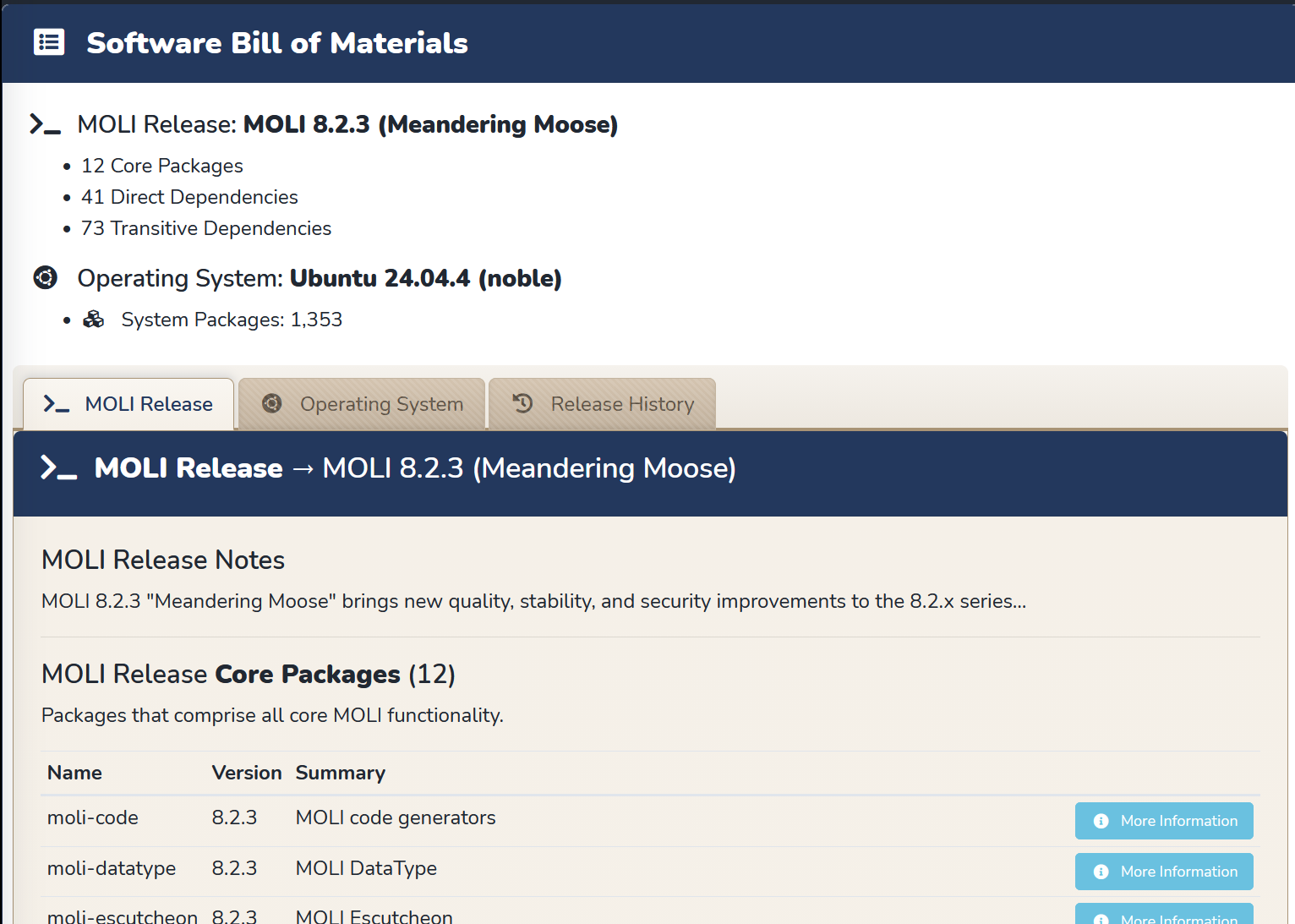
All third-party code is thoroughly evaluated before inclusion — license, history, and supply chain risk assessed by the designated Codemaster role. All code is pinned to specific versions, and served via private package infrastructure — eliminating the most common software supply chain attack vectors. A live SBOM Dashboard is available within each deployment for independent customer verification.
Audit & Compliance Logging
Every user action, configuration change, and system event is logged with who, what, when, and from where — persistently, in detail. Logs are available for export in standard, non-proprietary formats and surfaced in the MOLI dashboard for immediate review. MOLI's audit architecture is aligned with NIST 800-171, DoD CMMC, FDA 21 CFR Part 11, and ISO 9001/13485 requirements for electronic records, signatures, and traceability.
Quantum-Safe Cryptography
MOLI server infrastructure protects your production data against “harvest now, decrypt later” attacks that may occur as quantum computer hardware matures. Using NIST post-quantum algorithms, TLS connections to your MOLI deployment can negotiate ML-KEM key exchange (FIPS 203) in hybrid mode alongside classical algorithms.
Additional Security Features
Additional customer-configurable security features include:
- Application Firewall: restrict MOLI access by IP address; the systemwide allow list is extended by API- and Kiosk-specific rules
- Content Filter: inbound content scanning with logging / blocking of requests whose data include credit card numbers, banking numbers, social security numbers, or specific words
- Countersign Toolbox: verify identity using shared challenge words
- Malware Scanning: inbound file scanning with logging / blocking of requests whose files are infected with viruses
Quantum-Safe Cryptography — Ready Now, Protected for What's Next
Quantum computers capable of breaking conventional RSA and elliptic-curve cryptography are not yet widely deployed — but the threat is real and the timeline is advancing. The attack vector of “harvest now, decrypt later” means adversaries can intercept and archive encrypted traffic today, then decrypt it retroactively once sufficient quantum hardware is available. Production records, intellectual property, and personnel data collected now can become exposed in the future if the encryption protecting them is not quantum-resistant.
MOLI deploys on Ubuntu 26.04 LTS Server, the first Ubuntu long-term support release to ship NIST's finalized post-quantum cryptographic standards as platform defaults. Secure HTTP connections to your MOLI deployment are capable of negotiating ML-KEM (FIPS 203) key exchange in hybrid mode alongside classical ECDHE — so data in transit is protected against both current classical attacks and future quantum decryption simultaneously. No action is required from your IT team; post-quantum negotiation happens automatically when both endpoints support it, and falls back gracefully when they do not. Support for Post-Quantum TLS is available in MOLI version 8.3.0 and higher.
- ML-KEM (FIPS 203) — key encapsulation
- ML-DSA (FIPS 204) — digital signatures
- SLH-DSA (FIPS 205) — hash-based signatures
- Hybrid TLS — classical and post-quantum simultaneously
Standards Alignment
- NIST SP 800-171 / DoD CMMC — controlled unclassified information and defense cybersecurity controls
- FDA 21 CFR Part 11 — electronic records, e-signatures, and audit trails
- FDA 21 CFR Part 820 — medical device quality system regulations
- ISO 9001 / 13485 — records management, document control, and nonconformance traceability
- AS9100 / IATF 16949 — aerospace and automotive quality records
- ITAR / EAR / C-TPAT — controlled data handling and need-to-know access
- AWS SOC 2 Type II / ISO 27001 — infrastructure-level security assurance
- NIST FIPS 203 / 204 / 205 — post-quantum cryptographic standards
Security Culture
This document is provided for informational purposes only and does not constitute a warranty or guarantee of any specific security outcome or compliance determination. No technology or product can be completely secure. Security features, posture, and certifications are subject to change without notice.
- Co-Founder Steven L Smith and Principal Engineer Zach Kruchoski led security engineering on the Mykonos team at Juniper Networks — building enterprise-grade security appliances designed to protect web infrastructure from attackers
- The engineering team participates in hacker conferences and probes their own systems with the same adversarial curiosity
- A formal responsible disclosure program invites independent security researchers to audit the platform at any time
- Security incidents and near-misses feed directly into engineering retrospectives — findings are fixed, not filed
- All Perdix staff access to customer infrastructure is logged, time-bounded, and purpose-specific
- Third-party code is evaluated for supply chain risk before inclusion