
MOLI Radio Frequency Monitoring
for manufacturing · monitor · record · transcribe · analyze
The Plant Talks on the Radio. Now the Record Does Too.
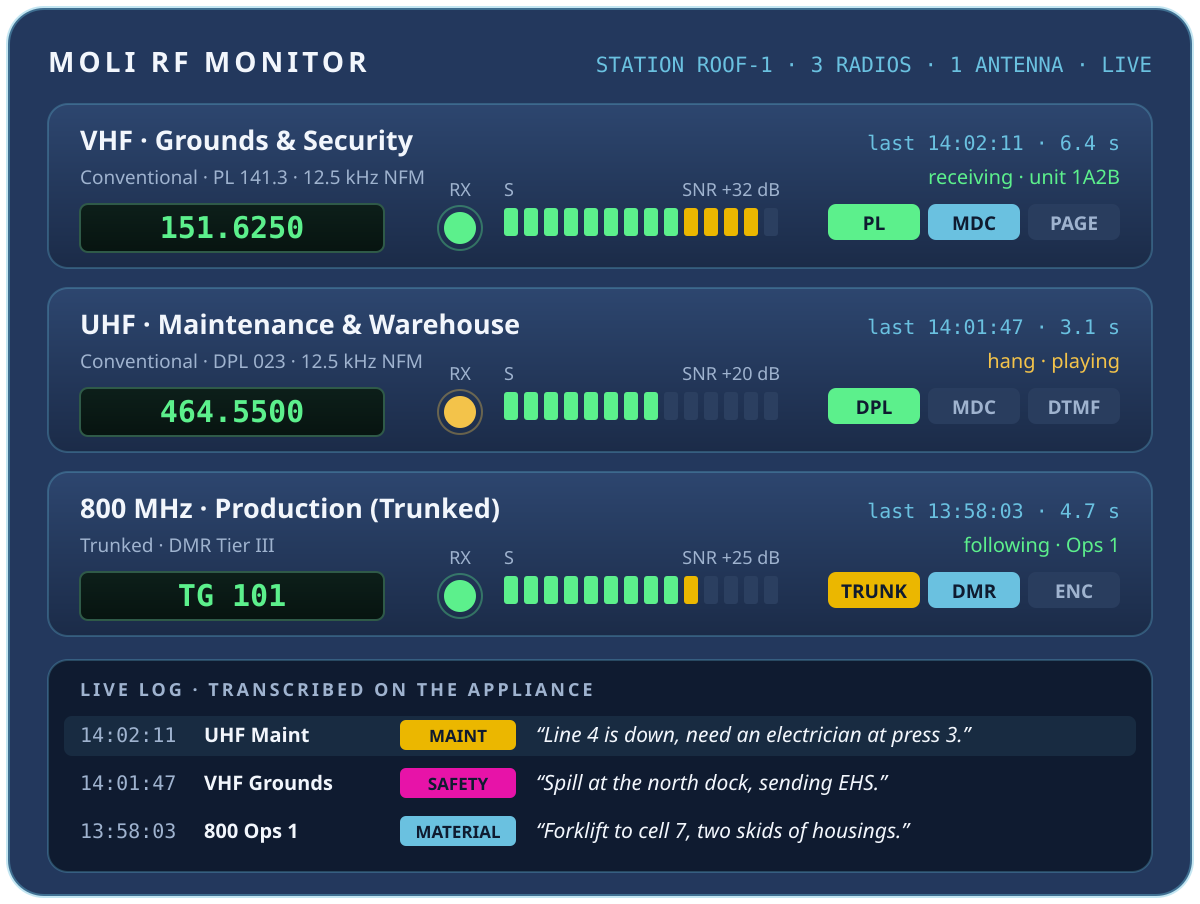
MOLI RF Monitor is a small box that listens to two-way radios, records every call, and turns the words into searchable text. It delivers all of it into MOLI, alongside the jobs, machines, escalations, and timeclock events your people were talking about.
For operations, the missing timeline. For EHS, the incident record. For compliance, proof of what each license is for.
Suppose You Run a Large Manufacturing Campus…
You hold a few FCC licenses across a few bands. Some were filed decades ago. Nobody is certain which still carry traffic, whether the radios on the charger are on the right channel, or what was said on Channel 5 in the minutes before the forklift hit the rack.
MOLI RF Monitor answers from the air. Every call becomes a timestamped transcribed record you can search and correlate.
What You Get:
- A complete record. Every call on every channel with time, channel, frequency, signal strength, and duration.
- Searchable speech. Transcribed on-device. Search a month of traffic for forklift, lockout, spill, or a part number.
- Who keyed up. Radio IDs (MDC-1200, P25, DMR) tie each call to a person, vehicle, or desk.
- Conversations, not just calls. Back-and-forth traffic is grouped and categorized.
- Context from the floor. Radio traffic lines up against Jobs, Machines, and Escalations on one timeline.
How It Works:
- Antenna on the roof. One wideband antenna near the center of your coverage area..
- The box listens. A Windows service watches every channel at once, performing Digital Signal Processing on the data coming from one or more Software Defined Radios.
- Every call is captured as its own audio file with time, channel, frequency, signal, duration, and whatever signaling it carried: tones, unit IDs, talkgroups, pages, DTMF, Morse.
- Speech becomes text on the box, primed with your site's vocabulary. Guardrails keep static from becoming sentences. Calls are grouped into conversations.
- Into MOLI over outbound HTTPS, on-premises or hosted, where it is correlated with everything else MOLI knows.
Three Audiences. One Record.
For Operations
- The leading indicator. “Line 4 is down” is on the radio minutes before it is in the ERP.
- Flow you can hear. Calls per hour by cell; shift handoffs, vehicle traffic.
For Environmental, Health & Safety
- Incidents and drills, reconstructed. First call, response, all-clear, word for word, attached to the MOLI Escalation.
- Words that page people. Man down, fire, spill: a watch-list word raises a MOLI Escalation, SMS, call, email, or overhead page; signal strength shows where radios don't reach.
For Compliance & License Management
- A license inventory that knows its usage. Callsign, frequencies, emissions, locations, and expiration beside each channel's airtime; a Part 90 license cancels after a year without operation (47 CFR §90.157).
- Problems on your channels. Wrong tone / CW logged; analysis of over-deviating transmitters.
In MOLI
- Stations, Channels & Licenses. Each box reports with a heartbeat; channels validated against FCC licenses.
- Call Log & Search. Full-text search across every channel; play calls in the browser; radio IDs map to People.
- Timelines. Radio calls appear on Job, Machine, Workcenter, Escalation, and Person timelines beside kiosk activity.
- Keyword Escalations. Watch-lists raise MOLI Escalations over SMS, voice, email, overhead page, and MOLI Chat.
- Reports, Exports & Signage. Channel and license utilization, station-ID compliance, unknown carriers, coverage; PDF, CSV, Excel; a Radio Traffic panel for the security desk.
- Retention & Hold. Retention policies and data holds by date range by channel; every play and download audited.
Technical Specifications
| Receiver | SDRplay RSP1B: 1 kHz to 2 GHz, 14-bit, 10 MHz window, one per band. VHF, UHF, and 700/800/900 MHz. Wider windows scanned by hopping |
| Services | FRS, GMRS, MURS, CB (AM), Marine VHF, Business and Industrial / Public Safety (Part 90), Amateur (Part 97), Aviation (Part 87), Railroad (AAR), NOAA Weather Radio, paging, itinerant, wireless microphones (Part 74) |
| Modes | Analog FM and AM; P25 Phase 1 and 2; DMR Tier II and III (MOTOTRBO, Capacity Max); Motorola SmartNet / SmartZone; NXDN; D-STAR; conventional, trunked, and multi-trunk systems |
| Signaling | CTCSS, DCS, MDC-1200, two-tone paging, CW / Morse ID, DTMF, MF, APRS; P25 NAC, talkgroup and unit / radio ID; DMR color code |
| Recording | Every call as its own file, first syllable kept, 16 kHz Opus, about 11 MB per hour of airtime; retention by days or gigabytes |
| Transcription | Whisper on the box, CPU or GPU (Vulkan, CUDA), primed with your site's vocabulary; guards against static and silence |
| Computer | Windows 10/11 or Server 2019 and later, x64, 4 or more cores, 16 GB; runs as a service; fully functional offline |
| Antenna | Wideband discone, lightning arrester, multicoupler. Receive only. |
| MOLI | Compatible with MOLI 8.3.1 or higher; requires additional license. |
| Digital voice | DVSI USB-3000 P25 family (AMBE+2, IMBE), 1, 3, or 12 channels. |